Career Search

Monday, September 5, 2016

UTI Capital Protection Oriented Scheme Series

UTI Mutual Fund has launched UTI Capital Protection Oriented Scheme Series VIII-I. The scheme will protect capital by investing in high quality fixed income securities. It will also invest in equity and equity related instruments. The minimum investment required is `5,000 and the scheme closes on 16 August.


-----------------------------------------------
Invest Rs 1,50,000 and Save Tax under Section 80C. Get Great Returns by Investing in Best Performing ELSS Mutual Funds

Top 10 Tax Saver Mutual Funds to invest in India for 2016

Best 10 ELSS Mutual Funds in india for 2016

1. BNP Paribas Long Term Equity Fund

2. Axis Tax Saver Fund

3. Religare Tax Plan

4. DSP BlackRock Tax Saver Fund

5. Franklin India TaxShield

6. ICICI Prudential Long Term Equity Fund

7. IDFC Tax Advantage (ELSS) Fund

8. Birla Sun Life Tax Relief 96

9. Reliance Tax Saver (ELSS) Fund

10. Birla Sun Life Tax Plan

Invest in Best Performing 2016 Tax Saver Mutual Funds Online

Invest Online

Download Application Forms

For further information contact Prajna Capital on 94 8300 8300 by leaving a missed call

---------------------------------------------

Leave your comment with mail ID and we will answer them

OR

You can write to us at

PrajnaCapital [at] Gmail [dot] Com

OR

Leave a missed Call on 94 8300 8300

-----------------------------------------------

Sunday, September 4, 2016

Mirae Asset Emerging Bluechip Fund

Mirae Asset Emerging Bluechip Fund Online

imggallery


-----------------------------------------------
Invest Rs 1,50,000 and Save Tax under Section 80C. Get Great Returns by Investing in Best Performing ELSS Mutual Funds

Top 10 Tax Saver Mutual Funds to invest in India for 2016

Best 10 ELSS Mutual Funds in india for 2016

1. BNP Paribas Long Term Equity Fund

2. Axis Tax Saver Fund

3. Religare Tax Plan

4. DSP BlackRock Tax Saver Fund

5. Franklin India TaxShield

6. ICICI Prudential Long Term Equity Fund

7. IDFC Tax Advantage (ELSS) Fund

8. Birla Sun Life Tax Relief 96

9. Reliance Tax Saver (ELSS) Fund

10. Birla Sun Life Tax Plan

Invest in Best Performing 2016 Tax Saver Mutual Funds Online

Invest Online

Download Application Forms

For further information contact Prajna Capital on 94 8300 8300 by leaving a missed call

---------------------------------------------

Leave your comment with mail ID and we will answer them

OR

You can write to us at

PrajnaCapital [at] Gmail [dot] Com

OR

Leave a missed Call on 94 8300 8300

-----------------------------------------------

Birla Sun Life MNC Online

Invest Birla Sun Life MNC Online
 

In the Small/Mid-Cap Equity category, Birla Sun Life MNC

Birla Sun Life MNC has been around since 1999, with the fund size having grown over 6 times its size over the past two years as opposed to the category which has doubled in size over the same period.

An experienced portfolio manager and his expertise in the small- and mid-cap segment make Birla MNC an appealing fund choice. Ajay Garg, senior fund manager with Birla Sun Life AMC, has been managing this fund since 2009 with a mandate to invest in securities of multinational companies, or MNCs. Garg's execution of strategy coupled with his expertise is a major driver for this fund.

Although not mandated to invest in the Small and Mid-Cap sector, the fund can tend to have upwards of half of their portfolio invested in this space. Given that the portfolio can tend to be slightly concentrated, there is the probability of a higher liquidity risk in the portfolio. Furthermore, a rally in the mid-cap space could impact performance.

The portfolio as on December 31, 2015 held about 40 stocks with about 69% of the assets being held in the top 10 holdings. Despite these factors leading to a riskier showing on the 'riskometer', the Birla MNC Fund has not failed to impress in terms of its performance.

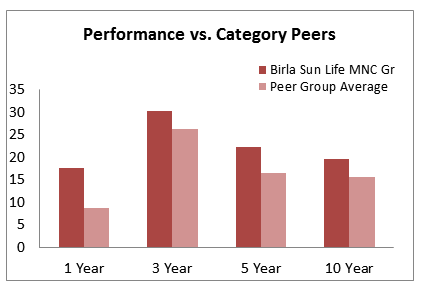
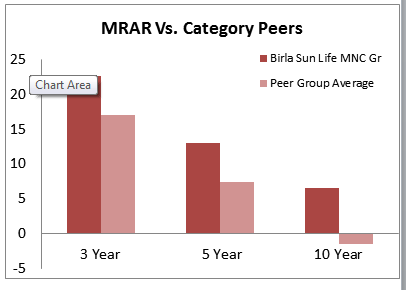
The fund has been one of the best performers in its category and returned 17.6% for CY15 as opposed to the category average of 8.81%. On a 3- and 5- year basis too, the fund managed to beat its category peers by a significant margin, returning 30.33% and 22.30% respectively, as opposed to a category average of 26.19% and 16.53%. On the Risk Adjusted Return Basis, the fund has had an impressive performance record, beating 82%, 95% and 97% of its peers on a 3-, 5- and 10-year basis respectively.

While the portfolio is sector heavy portfolio on pharmaceuticals, financials, auto and auto ancillaries, the stock bets within the financial sector seems to have contributed significantly towards the overall performance of the fund.
kavitha1

kavitha2

Mahesh Patil, Co-Chief Investment Officer, Birla Sun Life AMC, answers queries on the fund. 

  • Birla Sun Life MNC Fund stands out in terms of its character and philosophy. Could you take us through the strategy and process behind the success of the fund?

The philosophy of the fund is to invest in quality multinational companies operating in India that are present across geographies, right from developing to developed markets, so that they have a range of products and the requisite experience to launch the right product at right time.

In addition, these companies have the technological edge compared to their peers and strong global brands that can be leveraged upon.

The fund manager follows a research-based investment approach. He maintains a well-diversified portfolio with over 40 stocks across more than 15 sectors. He strives to maintain high quality by investing in stocks which have superior return ratios and strong balance sheet.

The fund manager uses a bottom-up approach to pick stocks of companies that offer solution oriented and affordable products. Though the portfolio allocation is tilted towards high quality mid- and small-cap companies, it still maintains a moderate risk profile.

  • The stock selection process seems to take various factors into considerations such as ESG, fundamentally strong companies, companies that offer higher liquidity and so on and so forth. Based on that, we would like to know what upside you seek to achieve from individual stocks and how do you look at them from a valuation perspective?

With a bottom-up approach to investing, lot of factors such as management strength, company's product profile, consumer/customer feedback, market size/share, corporate governance adherence, and valuation of stocks, play a role in deciding on the stocks merit to be part of the portfolio.

We work towards identifying high quality global companies which have a sizeable opportunity. In this process, the fund manager builds a portfolio mix of stocks which have superior return ratios and a strong balance sheet, hereby allowing the fund to deliver superior returns over a medium to long term period. From a valuation perspective these names trade at a premium due to perpetual high growth rate of these companies.

MNCs have historically commanded a higher premium and continue to do so on account of multiplicity of reasons, most common of which are scarcity premium, higher growth premium, premium for global brand / reach / technology etc.

The fund manager also gives a lot of importance to companies that work closely with the regulators and give due consideration to its external and internal stakeholders which include customers, employee and other non-promoter stakeholders.

  • Although you seem to give liquidity a lot of importance, the fund is highly concentrated with over 65% of its assets invested in the top 10 stocks. Could you take us through the risk factors on the fund and the process that are followed in order to mitigate these risks?

Though liquidity is important, it is not the most important factor as price discovery is generally correlated with liquid stocks. The fund manager's endeavor is to spot potential winners early. Having said that, the fund tries to keep a mix of liquid and semi liquid stocks (stocks where value unlocking is yet to be done) and also maintains adequate exposure to cash to meet day to day redemption requirements.

  • The fund has grown over six times over the past 2 years and is currently one of the largest funds in its category. While the increased interest in the fund is definitely a positive, does this impact stock selection and/or put any additional pressure on the management of the fund?

A strong research driven process helps in identifying new opportunities and the fund has been able to add new companies at periodic intervals.

We believe the size of opportunity in the MNC space is huge.  The MNC universe will keep increasing as India remains the fastest growing economy in the world and is fairly supported by government relaxation of FDI norms from time to time. For instance FDI in retail, insurance, aviation was relaxed recently. From that standpoint, there is further scalability room available for this product. The fund is currently compared within the MNC category only but can be compared with high quality focus diversified portfolios too.

-----------------------------------------------
Invest Rs 1,50,000 and Save Tax under Section 80C. Get Great Returns by Investing in Best Performing ELSS Mutual Funds

Top 10 Tax Saver Mutual Funds to invest in India for 2016

Best 10 ELSS Mutual Funds in india for 2016

1. BNP Paribas Long Term Equity Fund

2. Axis Tax Saver Fund

3. Franklin India TaxShield

4. ICICI Prudential Long Term Equity Fund

5. IDFC Tax Advantage (ELSS) Fund

6. Birla Sun Life Tax Relief 96

7. DSP BlackRock Tax Saver Fund

8. Reliance Tax Saver (ELSS) Fund

9. Religare Tax Plan

10. Birla Sun Life Tax Plan

Invest in Best Performing 2016 Tax Saver Mutual Funds Online

Invest Online

Download Application Forms

For further information contact Prajna Capital on 94 8300 8300 by leaving a missed call

---------------------------------------------

Leave your comment with mail ID and we will answer them

OR

You can write to us at

PrajnaCapital [at] Gmail [dot] Com

OR

Leave a missed Call on 94 8300 8300

-----------------------------------------------

Mutual Fund FMPs gave better returns than Bank FDs

Mutual Fund FMPs Invest Online
 
Mutual Funds article in Advisorkhoj - Top performing Mutual Fund FMPs gave better returns than Bank FDs

For capital safety and short term returns, bank fixed deposit is a natural choice for most Indian investors. However, fixed maturity plans (FMPs) offered by mutual funds are gaining popularity among more informed investors. Fixed maturity plans are close ended schemes that aim to generate income for the investors in a fixed term. FMP investors particularly favour FMPs maturing 12 – 15 months, because they get indexation benefit on taxes. Let us examine, why FMP is a smarter choice with actual one year data. In the last one year top performing FMPs have given better returns than bank fixed deposits, even on a pre tax basis. See the chart below for the top performing FMPs, based on last one year annualized returns (on a pre-tax basis). NAVs as Mar 14.

Mutual Funds - Top performing FMPs, based on last one year annualized returns

The chart above shows that on a pre-tax basis the top performing FMPs have given a return of 9.1 to 10.6%. Let us now compare the FMP returns with Fixed Deposit rates offered by leading banks, both in Public Sector and Private Sectors.

Mutual Funds - Comparison of FMP returns with Fixed Deposit rates of Public and Private Sectors

Clearly in terms of returns, FMPs have outperformed bank fixed deposits. Investors should, however, note that while FDs give assured returns, the returns of FMPs are not guaranteed. Unlike fixed deposits, FMPs may not be entirely risk free. The underlying portfolio of the FMPs may be exposed to credit risk. Most FMPs invest only in the highest rate debt paper (refer to the scheme documents) and so the risk is quite small, if at all. On historical basis, FMP returns have matched or beaten FD returns. Another point to note about FMPs is that, unlike FDs, there is virtually no liquidity before redemption of the scheme. What makes FMPs attractive is the tax efficiency of the investment. While FDRs are taxed at the applicable income tax slab rate of the tax payer, FMPs are subject to capital gains tax at 10.3% without indexation benefit and 20.6% with indexation benefit.

The table below illustrates the difference in post tax returns across different income tax slab rates, for an investment of Rs 1,00,000/- in a Bank FDR and an FMP, both offering a pre tax interest rate of 9%. The tenures of both the FDR and the FMP have been assumed to be little over 1 year.

Mutual Funds - Comparison of post tax returns for an investment of Rs 1,00,000/- in a Bank FDR and an FMP

Let us now compare how much Rs 1,00,000 invested in the top performing FMPs would have grown to, in comparison to the same amount invested in FDs, on a post tax basis. The investor in the highest tax bracket would have gained anywhere between Rs 3,000 to Rs 5,000 on a post tax basis, by investing in FMPs.

Mutual Funds - Comparison of post tax growth of Rs 1,00,000/- invested in FDs and an FMPs

Conclusion

The above clearly shows that FMPs are smart Investor's choice over fixed deposits for short to medium term. Risk averse investors or first time Investors should strongly consider investing in these. However, the Investors should also ensure that the objectives of the FMPs and time period are aligned with their individual risk profiles and time horizons. Therefore, they should consult with their financial advisors if the same is suitable for their investment portfolio.

-----------------------------------------------
Invest Rs 1,50,000 and Save Tax under Section 80C. Get Great Returns by Investing in Best Performing ELSS Mutual Funds

Top 10 Tax Saving Mutual Funds to invest in India for 2016

Best 10 ELSS Mutual Funds in india for 2016

1. BNP Paribas Long Term Equity Fund

2. Axis Tax Saver Fund

3. Franklin India TaxShield

4. ICICI Prudential Long Term Equity Fund

5. IDFC Tax Advantage (ELSS) Fund

6. Birla Sun Life Tax Relief 96

7. DSP BlackRock Tax Saver Fund

8. Reliance Tax Saver (ELSS) Fund

9. Religare Tax Plan

10. Birla Sun Life Tax Plan

Invest in Best Performing 2016 Tax Saver Mutual Funds Online

Invest Online

Download Application Forms

For further information contact Prajna Capital on 94 8300 8300 by leaving a missed call

---------------------------------------------

Leave your comment with mail ID and we will answer them

OR

You can write to us at

PrajnaCapital [at] Gmail [dot] Com

OR

Leave a missed Call on 94 8300 8300

-----------------------------------------------

Saturday, September 3, 2016

Dynamic Funds or Balanced Funds

Invest Dynamic Funds Online


Both dynamic and balanced funds determine their exposure to equity and debt asset classes based on market conditions, but balanced funds are tax-efficient and have a better long-term track record.
 
A mid high market volatility last year, investors took refuge in balanced funds. Net inflows into balanced funds, which in vest in a mix of equity and debt instruments, more than doubled to `19,743 crore in 2015-16. Steady returns and equity fund-like tax treatment have made them popular. But their more sophisticated cousins, the dynamic asset allocation funds, which have performed better over the past year, haven't got the same attention.
 
Here's why:


While both balanced and dynamic funds follow an asset allocation approach -- investing in debt and equity based on market conditions--they differ in their approach to juggling the asset mix. While balanced funds maintain a steady exposure to equity and debt, dynamic asset allocation funds switch aggressively. They can invest between zero and 100% in equity, depending on the market situation. The degree of flexibility is much wider in dynamic asset allocation. Balanced funds typically invest at least 65% of their corpus in equity, and the rest in debt. The equity portion varies between 65% and 75%.

The good and the bad

While both the categories attempt to contain volatility in returns, dynamic asset allocation funds score over balanced funds in this respect. Across different time frames, they have exhibited a lower standard deviation (around 0.4%)--a measure of volatility in a fund's return. So, even though balanced funds have delivered better returns over longer time frames, these have come at a slightly higher risk--standard deviation of over 0.7%--compared to dynamic funds.

What also works in favour of dynamic funds is they do away with the need to actively monitor and rebalance the portfolio. With rising equity market valuations, these funds will invest a larger portion of the corpus in debt and cash while cutting down on equities. Declining market valuations will automatically trigger ramp up in allocation to equities while slashing exposure to debt. Dynamic funds are beneficial to those who do not have the stomach for timing the market.Since the fund does the rebalancing automatically, they do not have to worry about where to put their money.

Dynamic asset allocation funds, however, fall short on tax efficiency. Equity-oriented balanced funds typically maintain a 65% exposure to equities, and qualify for better tax treatment compared with dynamic funds. Gains realised after one year are tax-free for the investor, even the debt portion incurs no tax. However, most dynamic asset allocation funds follow the Fund of Funds structure--where the fund invests in other equity and debt funds--so are taxed as non-equity funds, irrespective of their level of exposure to equities. For other schemes, which invest directly in stocks and bonds, the taxation depends on the average level of exposure to equities during the year. If at the time of exiting the scheme, it has maintained, on an average, 65% of its corpus in equities for that particular year, the scheme is treated as an equity fund for taxation purpose. Otherwise, any realised gains are taxed along the lines of a debt fund, making the scheme tax inefficient.

Another problem with dynamic funds is that their investing models are not alike. The different approaches may be difficult to understand. While most switch between equity and debt, based on the relative valuation of the two segments, they use different metrics to gauge the extent to which markets are underor over-valued. For instance, Franklin India Dynamic PE Ratio and Principal Smart Equity decides allocation based on the PE multiple of the underlying index, ICICI Prudential Dynamic Fund goes by the Nifty's price-to-book value and DSP BlackRock Dynamic Asset Allocation Fund considers the 10-year government bond yield over earn ings yield of the Nifty.

Dynamic Funds or Balanced Funds

Given their flexible structure, dynamic asset allocation funds should be best suited to capture market opportunities, but the aggressive rebalancing sometimes acts as a handicap for the funds as they cannot capture the market upside effectively. That is why experts say balanced funds are a better choice for managing risk for most investors. Investors would be better off with a flexible allocation within a narrower band with a plain vanilla balanced fund

-----------------------------------------------
Invest Rs 1,50,000 and Save Tax under Section 80C. Get Great Returns by Investing in Best Performing ELSS Mutual Funds

Top 10 Tax Saver Mutual Funds to invest in India for 2016

Best 10 ELSS Mutual Funds in india for 2016

1. BNP Paribas Long Term Equity Fund

2. Axis Tax Saver Fund

3. Franklin India TaxShield

4. ICICI Prudential Long Term Equity Fund

5. IDFC Tax Advantage (ELSS) Fund

6. Birla Sun Life Tax Relief 96

7. DSP BlackRock Tax Saver Fund

8. Reliance Tax Saver (ELSS) Fund

9. Religare Tax Plan

10. Birla Sun Life Tax Plan

Invest in Best Performing 2016 Tax Saver Mutual Funds Online

Invest Online

Download Application Forms

For further information contact Prajna Capital on 94 8300 8300 by leaving a missed call

---------------------------------------------

Leave your comment with mail ID and we will answer them

OR

You can write to us at

PrajnaCapital [at] Gmail [dot] Com

OR

Leave a missed Call on 94 8300 8300

-----------------------------------------------

SBI Blue Chip Fund

 Large-caps lend safety to this fund while mid-caps spice up the returns
 

After a choppy start, the bellwether indices have surged since their February low. Some early signs of a pick-up in corporate earnings and expectations of an above-normal monsoon are positives that can drive market sentiment. But increasing commodity and food prices can play spoilsport in the coming months. The market has also entered into a fickle territory post-Brexit.

Hence, investors with a low to medium risk appetite can opt for large-cap funds that limit the downside risk.

SBI Blue Chip is one of the top-performing funds in the large-cap category. Over the last five years, the fund has delivered annual returns of 16 per cent, outperforming the benchmark — BSE 100 that returned 8 per cent. Over one- and three-year periods, the fund has outperformed the benchmark by 6-8 percentage points. Moreover, the fund has beaten its peers, such as Franklin India Bluechip, Birla Sun Life Top 100, DSPBR Top 100 and UTI Top 100 over the last one-, three- and five-year periods.

The fund's performance has also been consistent; delivering better returns over its benchmark, 87 per cent of the time on an annual rolling return basis over the last five years.

Portfolio and strategy

The fund's equity holdings have ranged between 82 and 97 per cent. It has shifted allocations towards debt and cash whenever markets turned volatile.

For instance, in October last year, when markets turned jittery, the fund trimmed its equity holdings to about 82 per cent. It has now increased it to 88 per cent. The fund invests mainly in large-cap companies and about 15 per cent in mid-caps that provide a kicker to returns. Last year, the fund outperformed the benchmark comfortably by advancing 8 per cent.


Banks, pharma and software are the top preferred sectors. Over the last one year, the fund exited media & entertainment, telecom and transport sectors. Healthcare services and power got berths in the portfolio instead. The fund has also increased allocations in cyclicals, such as cement, over the past six months. The fund is overweight on sectors such as healthcare, automobile, construction and chemicals compared with its benchmark.

But, it is underweight on financials, software, energy and FMCG sectors.

The fund has 50 stocks with low churning of portfolio. The exposure to individual stocks is restricted to below 3 per cent except in the case of its top five holdings. This mitigates risks. HDFC Bank, Infosys, Reliance Industries, Sun Pharmaceutical and Tata Motors are its top five holdings.

HDFC Bank and Infosys have fared well in the last one year. It added Mahindra & Mahindra last August.

Other stocks the fund added recently are Aurobindo Pharma, HCL Technologies, PI Industries and Eicher Motors; these are likely to yield returns in the long run.

-----------------------------------------------
Invest Rs 1,50,000 and Save Tax under Section 80C. Get Great Returns by Investing in Best Performing ELSS Mutual Funds

Top 10 Tax Saver Mutual Funds to invest in India for 2016

Best 10 ELSS Mutual Funds in india for 2016

1. BNP Paribas Long Term Equity Fund

2. Axis Tax Saver Fund

3. Franklin India TaxShield

4. ICICI Prudential Long Term Equity Fund

5. IDFC Tax Advantage (ELSS) Fund

6. Birla Sun Life Tax Relief 96

7. DSP BlackRock Tax Saver Fund

8. Reliance Tax Saver (ELSS) Fund

9. Religare Tax Plan

10. Birla Sun Life Tax Plan

Invest in Best Performing 2016 Tax Saver Mutual Funds Online

Invest Online

Download Application Forms

For further information contact Prajna Capital on 94 8300 8300 by leaving a missed call

---------------------------------------------

Leave your comment with mail ID and we will answer them

OR

You can write to us at

PrajnaCapital [at] Gmail [dot] Com

OR

Leave a missed Call on 94 8300 8300

-----------------------------------------------

Friday, September 2, 2016

ICICI Prudential Health Saver Plan

ICICI Prudential health saver plan is an expensive health plan


This a very expensive unit linked health insurance plan because of the investment element in it


As you have found, ICICI Prudential Health Saver is a unit linked health insurance plan with a combination of health insurance and an investment element. The health insurance portion takes care of medical expenses in case of hospitalisation and the investment portion builds a health fund which takes care of expenses not covered in this hospitalisation benefit. This a very expensive plan because of the investment element in it.


The premium payment after deduction of allocation charges, administration charges, Insurance charges gets invested in a portfolio termed as Health Savings Fund. This Fund can be used after 3 completed policy years in the percentages specified, for the reimbursement of health care costs incurred like on medicines and drugs, diagnostic expenses, dental expenses, co-pays in medical insurance and other miscellaneous medical expenses not covered in medical insurance.


These type of policies are sold hard due to attractive commissions for the agent. For the same premium amount that you pay for this policy, you can get a pure health cover of up to R8-10 lakh for your family. Unfortunately, this policy does not have a surrender option and hence you can claim from the health saving fund (if expenses incurred) or continue the policy or just let the policy lapse and bear the loss.


It would more cost effective to take a stand alone health insurance policy. A family floater will be a good option for you to include your child.


Here are a few recommended family floater health plans based on your requirement. These plans have value added coverage or in built coverage of critical illness cover, hospitalization, pre and post hospitalization, medical check, accident cover etc.


These insurers have good past claim record too. You decide the adequate amount of cover based on your lifestyle, current health conditions and your family history of illnesses. Compare the benefits and features and the premium applicable for your age.


The recommended plans are:
ICICI Lombard Complete Health Insurance
Religare Health Care
Apollo Munich Health Optima Restore


-----------------------------------------------
Invest Rs 1,50,000 and Save Tax under Section 80C. Get Great Returns by Investing in Best Performing ELSS Mutual Funds

Top 10 Tax Saver Mutual Funds to invest in India for 2016

Best 10 ELSS Mutual Funds in india for 2016

1. BNP Paribas Long Term Equity Fund

2. Axis Tax Saver Fund

3. Religare Tax Plan

4. DSP BlackRock Tax Saver Fund

5. Franklin India TaxShield

6. ICICI Prudential Long Term Equity Fund

7. IDFC Tax Advantage (ELSS) Fund

8. Birla Sun Life Tax Relief 96

9. Reliance Tax Saver (ELSS) Fund

10. Birla Sun Life Tax Plan

Invest in Best Performing 2016 Tax Saver Mutual Funds Online

Invest Online

Download Application Forms

For further information contact Prajna Capital on 94 8300 8300 by leaving a missed call

---------------------------------------------

Leave your comment with mail ID and we will answer them

OR

You can write to us at

PrajnaCapital [at] Gmail [dot] Com

OR

Leave a missed Call on 94 8300 8300

-----------------------------------------------